2-Variable K-Map Solver
Click each cell to cycle through 0, 1, and X for don't care. Then solve the map.
B: 0 1
A

Math Calculators
Use this Karnaugh map calculator page to solve 2-variable K-map, 3-variable K-map, and 4-variable K-map problems, simplify Boolean functions, minimize SOP and POS equations, and generate a logical diagram of the simplified equation. These K-map solvers are designed for digital logic, Boolean algebra, and computer engineering students.
Solve a 2-variable Karnaugh map with interactive cells.
Minimize a 3-variable K-map and review groups and equations.
Simplify a 4-variable K-map with SOP, POS, and diagram output.
Enter minterms and don't-cares directly to simplify the function.
A Karnaugh map groups adjacent 1 values or 0 values in Gray code order so a Boolean function can be minimized visually. Grouping larger blocks leads to simpler logic expressions and fewer logic gates.
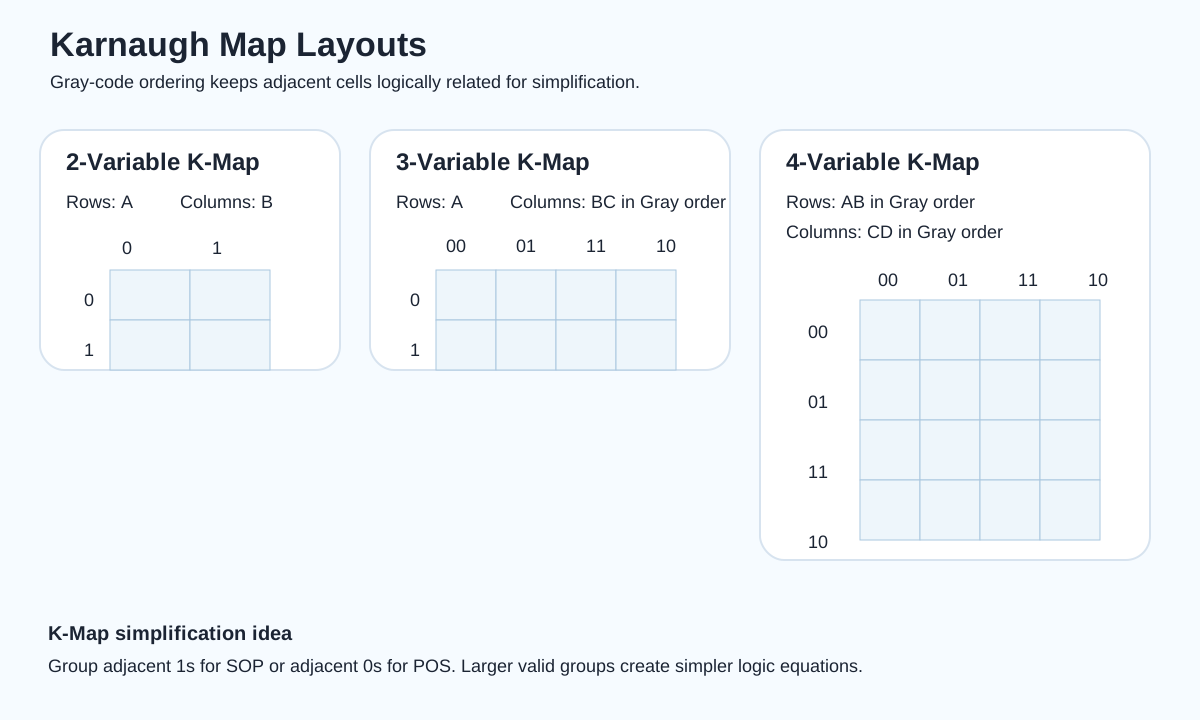
Click each cell to cycle through 0, 1, and X for don't care. Then solve the map.
Fill the 3-variable Karnaugh map in Gray code order and generate the minimized equation.
Use the full 4-variable K-map to minimize larger Boolean functions and create a logic diagram.
Enter minterms and optional don't-care terms directly for a faster Karnaugh map simplification workflow.
A Karnaugh map calculator is a Boolean simplification tool that helps users reduce logic expressions by grouping adjacent cells in a K-map. A 2-variable K-map solver is useful for simple logic functions, a 3-variable K-map solver supports medium-sized problems, and a 4-variable K-map solver handles larger truth-table patterns used in digital logic design.
A strong K-map simplification calculator should support minterms, maxterms, don't-care conditions, minimized SOP output, minimized POS output, and a clear logical diagram of the final equation. This page includes all of those features in one place.
For the interactive K-map solvers, click the cells until each cell shows 0, 1, or X. Then run the solver to see the minterms, maxterms, simplified SOP equation, simplified POS equation, and the generated logic diagram. Use X for don't-care conditions when those terms can be grouped during simplification.
For the direct K-map simplification calculator, enter the minterm list and optional don't-care list, choose the variable count, and solve. This is useful when your teacher or textbook already gives the minterms and you want the minimized Boolean expression quickly.
This Karnaugh map calculator works best when used together with the Boolean algebra calculators for truth tables and canonical forms, the logic gate calculators for output checking, the flip-flop and sequential logic calculators for state-based design, and the code conversion calculators for binary and Gray-code topics used in digital systems.
Learn more from Karnaugh map, Quine-McCluskey algorithm, Disjunctive normal form, and Conjunctive normal form.